Helping children understand and express their emotions doesn’t always come easily. And that’s why I designed this emotional check-in for kids free printable To give you a simple way to help children pause, notice how they are feeling, and think about what they need.
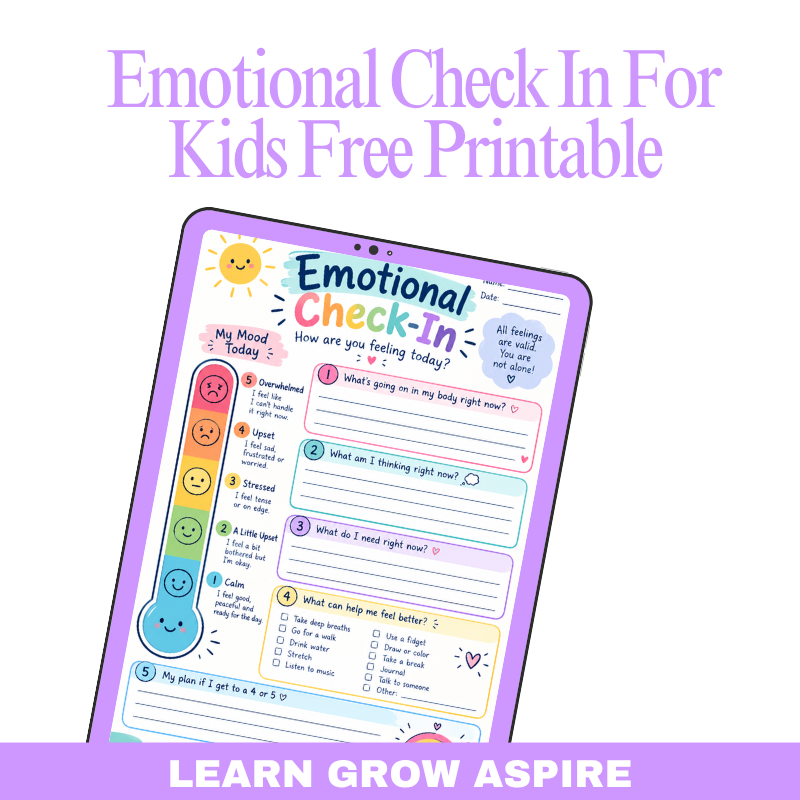
The printable includes a kid-friendly feelings thermometer and reflection prompts that can be used at home, in the classroom, during counseling sessions, or as part of a social-emotional learning routine.
We are all aware that kids experience big emotions every day.
They may feel excited about a birthday, nervous about a test, frustrated with a friend, worried about something happening at home, or overwhelmed by a situation they don’t know how to handle.
Sometimes, children know they don’t feel good but don’t have the words to explain why.
That’s where a simple emotional check-in (like the one below) can help.
What Is an Emotional Check-In for Kids?
An emotional check-in is a simple opportunity for a child to stop and ask:
How am I feeling right now?
It can be as simple as choosing a feeling from a chart, pointing to an emotion, coloring a thermometer, drawing a picture, or answering a few questions.
The goal isn’t to make children give a long explanation about their feelings.
Instead, an emotional check-in can help create a moment of awareness.
Children can begin to notice:
- What emotion are they experiencing?
- How strong is their feeling?
- What is happening to their body?
- What thoughts they are having?
- What might they need right now?
- What could help them feel more comfortable?
A feelings thermometer is one visual way to make this process easier.
Why Emotional Check-Ins Are Helpful for Kids
Children are still developing the ability to identify, communicate, and manage emotions.
A child may know they’re upset without knowing whether they’re feeling disappointed, frustrated, embarrassed, worried, angry, or overwhelmed.
Regular emotional check-ins can give children opportunities to practice putting words to their experiences.
1. They build emotional awareness
The first step toward managing an emotion is often recognizing that the emotion is there.
A check-in gives children a chance to stop and notice what is happening internally.
For example:
“I’m feeling frustrated.”
is more specific than:
“I’m having a bad day.”
Over time, children can develop a larger emotional vocabulary and become more comfortable talking about their feelings.
2. They help children notice emotional intensity
Not every feeling is experienced at the same level.
A child might be:
- A little nervous
- Very nervous
- Extremely worried
A feelings thermometer can help children think about the intensity of an emotion.
For example, a child might say:
“I’m at a 2 right now.”
Later, the same situation might become:
“Now I’m at a 4.”
This gives adults another opportunity to ask:
“What could help you before that feeling gets even bigger?”
3. They encourage communication
Some children don’t want to sit down and have a long conversation about their emotions.
That’s okay.
A visual worksheet can give them another way to communicate.
They might:
- Circle an emotion
- Draw what happened
- Write one word
- Point to a feeling
- Choose a coping strategy
The check-in becomes a starting point for conversation rather than an interrogation.
4. They support social-emotional learning
Emotional check-ins can easily become part of an SEL routine.
You can use them to introduce concepts such as:
- Self-awareness
- Emotional vocabulary
- Self-regulation
- Coping skills
- Problem-solving
- Communication
- Reflection
What Is a Feelings Thermometer?
A feelings thermometer for kids is a visual tool that helps children think about how strong an emotion feels to them.
Just like a regular thermometer shows temperature, a feelings thermometer can represent emotional intensity.
For example:
1 – Calm
2 – A Little Upset
3 – Frustrated
4 – Very Upset
5 – Overwhelmed
The exact labels can be adjusted depending on the child’s age and needs.
The important idea is that feelings can change.
A child doesn’t have to stay at a “5.”
They can learn to notice where they are and identify strategies that may help them move toward a calmer state.
Free Emotional Check-In for Kids Printable
I created this free emotional check-in for kids printable to make emotional check-ins simple, visual, and kid-friendly.
It’s designed to give children a quiet opportunity to pause and think about what’s happening inside.
The printable encourages children to explore questions such as:
- How am I feeling right now?
- What is happening in my body?
- What am I thinking?
- In this moment, what do I need?
- What could help me feel better?
- What is my plan if my feelings get really big?
These questions can be completed independently by older children or discussed together with you.
How To Use the Emotional Check-In Printable
One of the best things about an emotional check-in is that it doesn’t have to take a lot of time.
Here are some simple ways to use the printable.
1. Use It as a Morning Check-In
If you’re a classroom teacher, you can use the worksheet as part of a morning routine.
Have your students take a few minutes to identify how they are feeling when they arrive at school.
This can be especially helpful after a difficult morning, a change in routine, or an event that may be affecting a child emotionally.
You don’t necessarily need every child to share their answers publicly.
The check-in can simply be a private reflection.
2. Use It During a Classroom Transition
Transitions can sometimes be challenging for children.
Consider using an emotional check-in:
- After recess
- Before a test
- After lunch
- Before dismissal
- After a conflict
- Before a challenging activity
A quick check-in can give children a moment to pause before moving into the next part of their day.
3. Use It in the School Counseling Office
If you are a school counselor, you can use this printable as a conversation starter.
Instead of beginning with:
“Tell me what’s wrong.”
you might begin with:
“Let’s take a look at how you’re feeling today.”
The child’s answers can help guide the conversation.
For example, if a child identifies that they’re feeling frustrated, you could explore:
- What happened?
- Where do you notice frustration in your body?
- What thoughts are you having?
- What have you tried?
- What might help right now?
The worksheet doesn’t need to provide all the answers. Its purpose can simply be to open the door to a conversation.
4. Use It at Home
As a parent, you can also make emotional check-ins part of everyday family life.
Try using the printable:
After school:
“How was your day emotionally?”
After an argument:
“Let’s check in and see what you’re feeling.”
Before bedtime:
“What feeling are you taking with you into tonight?”
During a difficult moment:
“Where are you on your feelings thermometer?”
The goal isn’t to eliminate uncomfortable emotions.
It’s to help children become more comfortable noticing and talking about them.
5. Add It to a Calm Corner
If you have a classroom calm corner or quiet space, consider keeping copies of the printable nearby.
A child who is feeling overwhelmed may not be ready to talk immediately.
Having a visual tool available can give them another way to communicate.
You could pair the emotional check-in with other calming resources such as:
- Breathing exercises
- Drawing
- Quiet reading
- Sensory activities
- Positive self-talk
- Mindfulness
- Movement breaks
- Coping skills cards
The check-in can become the first step:
Notice → Name → Understand → Choose a strategy
What Should You Ask After an Emotional Check-In?
The worksheet is only the beginning.
Once your kiddo identifies a feeling, try asking open-ended questions rather than immediately trying to solve the problem.
For example:
If they say they’re angry:
“What happened?”
If they say they’re worried:
“What is your worry telling you?”
If they say they’re frustrated:
“What part feels hardest right now?”
If they say they’re overwhelmed:
“What would make things feel a little easier?”
If they choose a high level on the thermometer:
“What do you think your body needs right now?”
These questions encourage children to reflect rather than simply being told what they should do.
Help Kids Understand That Feelings Change
One important message to reinforce during emotional check-ins is:
Feelings are temporary.
A child might be at a 5 right now, but that doesn’t mean they will always feel like a 5.
Emotions can change depending on:
- What happened
- What we are thinking
- Who we are with
- Our environment
- Our physical needs
- The support we receive
- The strategies we use
This doesn’t mean children should be told to “calm down” or simply make an uncomfortable feeling disappear.
Instead, we can help children understand that emotions provide information and that they can learn different ways to respond to them.
Emotional Check-In vs. “How Are You Feeling?”
Sometimes we ask children:
“How are you feeling?”
and get:
“Fine.”
Sound familiar?
A more structured emotional check-in can give children something concrete to respond to.
Instead of requiring them to come up with an answer from scratch, you can provide visual choices and prompts.
For younger children, this might mean:
“Point to the face that shows how you feel.”
For older children:
“Where are you on the feelings thermometer?”
Then:
“What do you think you need?”
This creates a natural progression from identifying a feeling to thinking about what might help.
Make Emotional Check-Ins a Routine
You don’t need to wait until a child is having a huge emotional reaction to use an emotional check-in.
In fact, I would recommend practicing when children are relatively calm can make the process more familiar.
Try making it part of a routine.
At school:
Monday: Morning check-in
Tuesday: Feelings vocabulary
Wednesday: Body clues
Thursday: Coping strategies
Friday: Reflection
At home:
You could do a quick check-in:
Before school → After school → Before bed
It doesn’t have to take more than a few minutes.
The goal is consistency rather than perfection.
Tips for Making Emotional Check-Ins Work
Keep it simple – You don’t need a complicated worksheet or a long conversation. A few meaningful questions can be enough.
Don’t force children to share – A child may be comfortable identifying a feeling but not ready to explain it.
Give them time.
Avoid judging emotions – Try not to label feelings as “good” or “bad.” Children need to know that having an emotion doesn’t make them a bad person. The focus should be on understanding the emotion and choosing safe, helpful ways to respond.
Model it yourself – as an adult, you can participate too.
You might say:
“I’m feeling a little frustrated right now, so I’m going to take a few deep breaths before I respond.”
This shows your child or students that emotional awareness isn’t just something they need to learn.
Adults use these skills too.
Focus on progress – The goal isn’t for children to correctly identify every emotion immediately. Emotional vocabulary develops over time. You can choose to celebrate small steps such as:
“You noticed you were getting frustrated before it became really big. That’s important.”
Who Can Use This Free Printable?
This emotional regulation printable can be useful for:
- Parents
- Teachers
- School counselors
- SEL educators
- Social workers
- Therapists
- Child-care providers
- Homeschool families
- Special education professionals
- Elementary classrooms
It can be used with individual children, small groups, or as part of a larger social-emotional learning routine.
For younger children, you can read the questions aloud and allow them to point, draw, or verbally answer.
Older elementary students may be able to complete more of the worksheet independently.
Emotional Check-Ins Are About Connection, Not Perfection
An emotional check-in isn’t meant to “fix” a child’s feelings. But rather an opportunity to slow down and connect.
Sometimes a child needs a coping strategy. Other times, they simply need someone to listen.
And the most helpful response is:
“I’m here. You don’t have to figure this out by yourself.”
When children regularly have opportunities to talk about emotions, they can gradually become more comfortable recognizing and communicating what is happening inside.
A simple activity like this one can be one small tool that helps make those conversations easier.
Download Your Free Emotional Check-In for Kids Printable
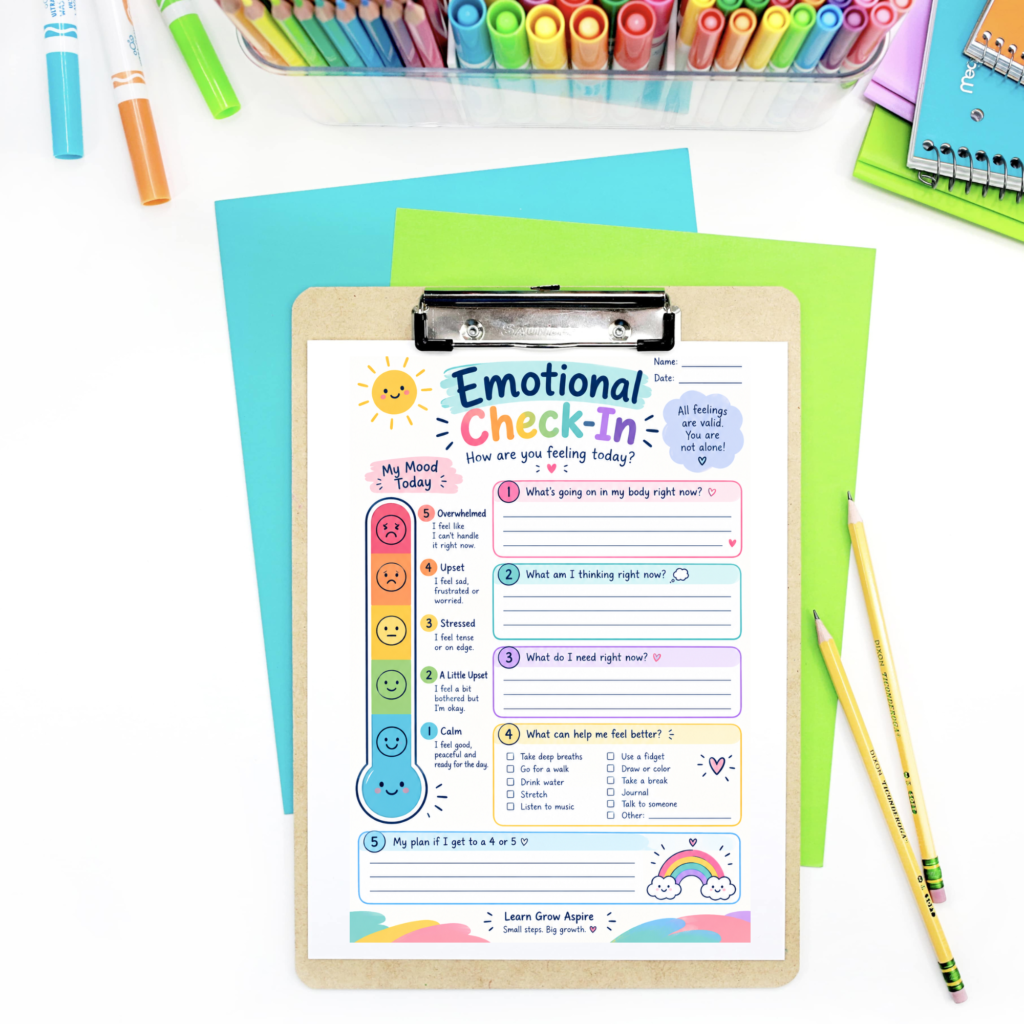
If you’re looking for a simple emotional check-in for kids free printable to use at home, in the classroom, or during counseling, I hope this resource gives you an easy place to start.
The printable helps children:
- Identify their current emotions
- Think about the intensity of their feelings
- Notice physical and emotional clues
- Reflect on their thoughts
- Identify what they need
- Think about coping strategies
- Create a plan for big feelings
Get your FREE printable here:
Click on the link below to snag your free PDF.
Keep it somewhere easy to access and return to it regularly. The more opportunities children have to practice identifying their emotions when they’re calm, the more familiar the process can become.
Helping Kids Regulate Their Emotions
Teaching children about emotions doesn’t have to involve complicated activities.
Sometimes, a few minutes of intentional reflection can make a difference.
A simple emotional check-in for kids can help children pause, identify what they’re feeling, and begin thinking about what they need.
Whether you’re a parent looking for a way to talk about feelings at home, a teacher building SEL into your classroom routine, or a counselor supporting a child through big emotions, a visual emotional check-in can be a practical tool to keep nearby.
Small conversations can build important emotional skills over time because children don’t need to have all the answers.
They just need opportunities to learn, practice, and grow.
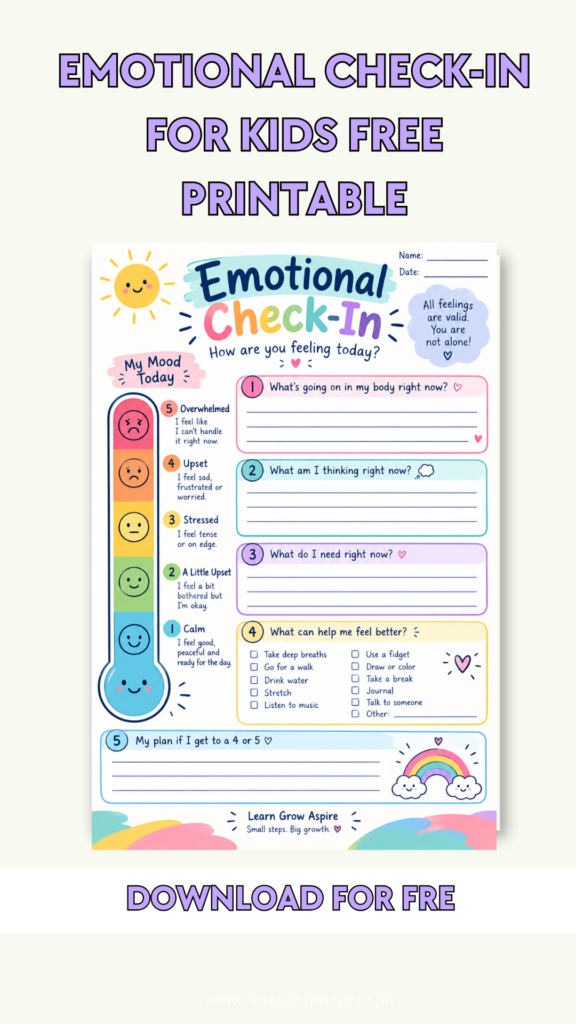
Pin This Free Emotion Check-In for Kids PDF
Save this printable PDF to your Kids Pinterest SEL board so you can easily access it when needed. And while on Pinterest, please consider following me there. I would really appreciate it.
Some of the links in this post may be affiliate links. I’m also an Amazon Affiliate and will occasionally link to some of my favorite Amazon products. I will receive a small percentage back if you purchase through my link. You won’t be charged a penny more if you shop through my links. That said, I do NOT recommend anything I do not use and love! Thank you for helping support my blog!


Leave a Reply