Positive affirmations for kids can be a simple but meaningful way to help children develop confidence, self-awareness, resilience, and a kinder inner voice. When children regularly hear and practice encouraging statements about themselves, they have an opportunity to pause, notice their thoughts, and begin replacing negative self-talk with more supportive language.
As parents, teachers, and/or school counselors, we know that children don’t always see themselves the way we see them.
A child may be capable but think, “I’m not good at this.”
They may make one mistake and decide, “I can’t do anything right.”
They may feel nervous about trying something new, struggle with a friendship, or have a difficult day at school.
This is where positive affirmations can become one small tool in a child’s social-emotional learning toolbox.
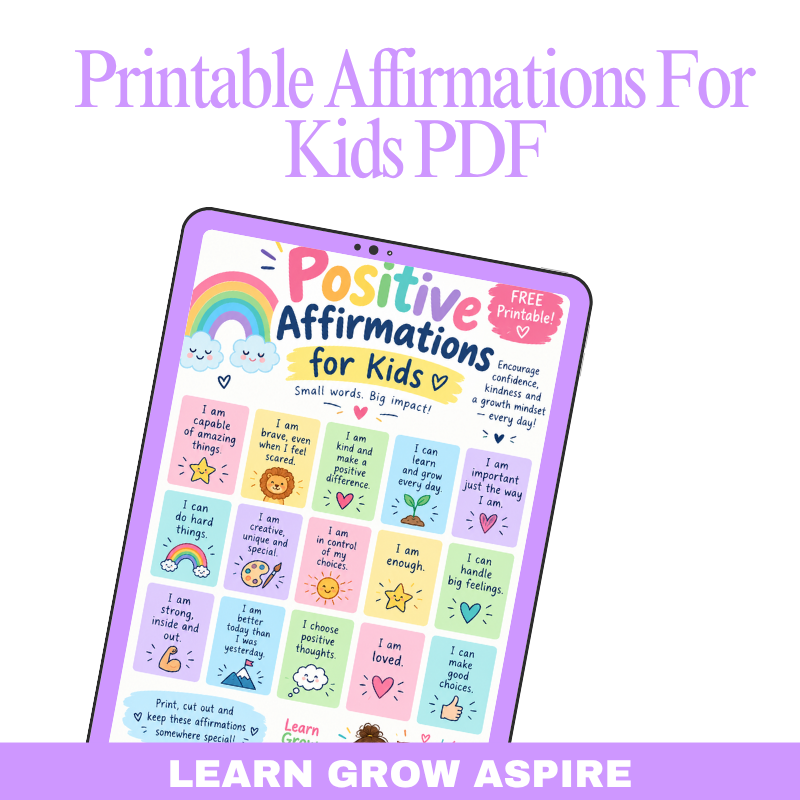
To help you get started, I created a free positive affirmations for kids printable that you can use at home, in your classroom, during counseling sessions, or as part of a morning SEL routine.
SCROLL TO THE END TO DOWNLOAD!
What Are Positive Affirmations for Kids?
Positive affirmations are short, encouraging statements that children can repeat to themselves to reinforce helpful ways of thinking.
For example:
- I am brave enough to try.
- I can learn new things.
- I can make mistakes and keep learning.
- I am proud of my effort.
- I can handle big feelings.
- I can ask for help when I need it.
- I am enough just as I am.
The goal isn’t to convince a child that everything is always wonderful or that difficult feelings don’t exist.
Instead, affirmations can help children develop a more balanced and compassionate way of talking to themselves.
A child who says, “I can’t do this,” might eventually learn to shift that thought toward, “This is hard, but I can try one step at a time.”
That small change in their language can be powerful.
Why Positive Self-Talk Matters
Children are constantly learning—not only academic skills, but also how to understand themselves and respond to challenges.
Their internal dialogue can influence how they approach mistakes, unfamiliar situations, friendships, schoolwork, and difficult emotions.
When children develop positive self-talk, they can begin to practice thoughts such as:
- “I can try again.”
- “I don’t have to be perfect.”
- “I can ask for help.”
- “My feelings are okay.”
- “I can handle this one step at a time.”
These statements don’t remove frustration, disappointment, anxiety, or uncertainty. Instead, they give children language they can use while experiencing those feelings.
That makes affirmations especially useful when paired with other SEL strategies such as emotional regulation, mindfulness, problem-solving, growth mindset, and coping skills.
30 Positive Affirmations for Kids
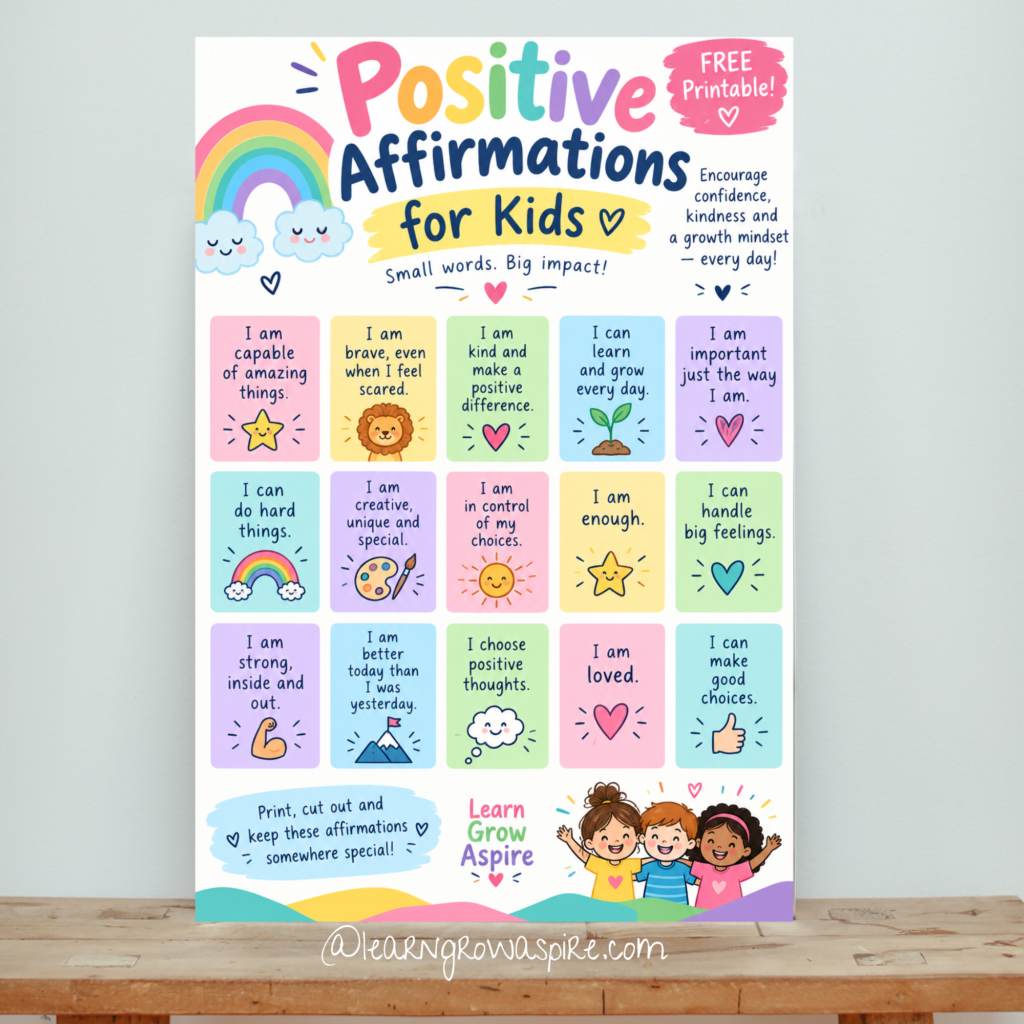
Here are some child-friendly affirmations you can introduce at home, in your classroom, or during counseling sessions.
Confidence & Self-Esteem
- I believe in myself.
- I am capable of amazing things.
- I am important just the way I am.
- I have good ideas.
- I am unique and special.
- I am enough just as I am.
- I can be myself.
- I bring something special to the world.
Resilience & Growth
- I can learn new things.
- I can make mistakes and keep learning.
- I can try again.
- I am growing every day.
- I am proud of my effort.
- I can solve problems one step at a time.
- I can face challenges with courage.
- I can celebrate small wins.
Emotional Regulation
- My feelings are okay.
- I can handle big feelings.
- I can take a deep breath and calm my body.
- I can be patient with myself.
- I am stronger than a difficult moment.
- I can focus on what I can control.
Kindness & Relationships
- I am kind and caring.
- I am a good friend.
- I can choose kind words.
- My voice matters.
- I can ask for help when I need it.
- I am worthy of kindness and respect.
Positive Choices
- I can make a positive choice.
- I can make good choices.
These don’t need to be memorized all at once. In fact, choosing one affirmation at a time may be much more meaningful for a child.
How to Use Positive Affirmations With Kids
One of the best things about affirmations is that they don’t require a complicated lesson plan.
Here are some simple ways to incorporate them into everyday routines.
1. Start the School Day With an Affirmation
Choose one affirmation for the class to practice each morning.
Write it on the board or display it somewhere children can see it.
For example:
“I can learn new things.”
Ask students to read it together.
Then ask:
“What could this look like today?”
Students might respond:
- Trying something that feels difficult
- Asking a question
- Learning from a mistake
- Trying a new activity
- Practicing something they haven’t mastered yet
This turns the affirmation into an action rather than simply repeating words.
2. Use Them During Counseling Sessions
As a school counselor, you can use affirmations as a starting point for conversations about self-esteem, anxiety, confidence, friendship, coping skills, or challenging situations.
Choose an affirmation that connects with the child’s current goal.
For example, a child struggling with mistakes might choose:
“I can make mistakes and keep learning.”
You can then explore:
- What does this affirmation mean?
- When is it hard to believe?
- What happens when you make a mistake?
- What could you say to yourself instead?
- What is one small way you could practice this today?
This can turn a simple affirmation into a meaningful SEL conversation.
3. Create an Affirmation Jar
An affirmation jar is an easy activity for both classrooms and families.
Write different affirmations on small pieces of paper and place them in a jar.
Each morning—or whenever a child needs encouragement—choose one.
You can make it more interactive by asking the child to:
Read it → Talk about it → Draw it → Practice it
For younger children, drawing what the affirmation means can be especially helpful.
4. Put an Affirmation in a Backpack or Lunchbox
A tiny note can encourage your child to keep going during the school day.
Write:
“You are brave.”
or
“You can try again.”
or
“Believe in yourself!”
and place it somewhere your child will find it.
These small reminders can become meaningful rituals over time.
5. Use Affirmations During Difficult Moments
Affirmations don’t have to happen only when everything is going well.
They can be especially useful when a child is frustrated or discouraged.
If a child says:
“I can’t do this!”
Instead of immediately responding with “Yes, you can!”, try helping them find a more realistic and supportive thought.
For example:
“This feels really hard right now. What could we tell ourselves?”
Then introduce:
“I can do hard things.”
The important part is acknowledging the child’s experience rather than dismissing it.
Positive Affirmations and Growth Mindset
Positive affirmations can work particularly well alongside growth mindset activities.
There is an important difference between saying:
“I’m the best at everything.”
and:
“I can keep learning and improving.”
The second statement leaves room for mistakes and challenges.
Children don’t need to believe they are perfect.
They need opportunities to understand that their abilities can develop, their effort matters, mistakes are part of learning, and challenges don’t define them.
That is why many of the affirmations in this printable focus on effort, learning, trying again, and handling difficult moments.
Instead of teaching children to avoid negative experiences, we can help them develop language for moving through those experiences.
How To Use These Affirmations at Home
As a parent, you can incorporate affirmations into routines children already have.
Try choosing one affirmation at breakfast, before school, at bedtime, or after a challenging day.
You could even make it part of a simple family routine:
Parent: “What’s our affirmation today?”
Child: “I can try again.”
Parent: “When might you need that today?”
This creates an opportunity for conversation without turning it into a lecture.
You can also model positive self-talk yourself.
Children learn a great deal from the way adults talk about themselves.
Instead of saying:
“I’m terrible at this.”
try modeling:
“This is new for me, but I can keep practicing.”
Instead of:
“I always mess things up.”
try:
“That didn’t go the way I wanted. I’ll think about what I can do differently next time.”
Children don’t need to hear adults pretend that everything is easy.
They benefit from seeing adults handle mistakes with self-compassion and persistence.
A Simple Affirmation Activity for Kids
Try this three-step activity:
Step 1: Choose – Have the child choose an affirmation that feels meaningful to them.
Step 2: Personalize – Ask: “When would you need to remember this?” For example: “I can be brave when I have to try something new.”
Step 3: Practice – Have the child say the affirmation, draw a picture representing it, or write about a time they could use it.
This makes the activity more personal than simply asking children to repeat a statement.
Free Positive Affirmations for Kids Printable
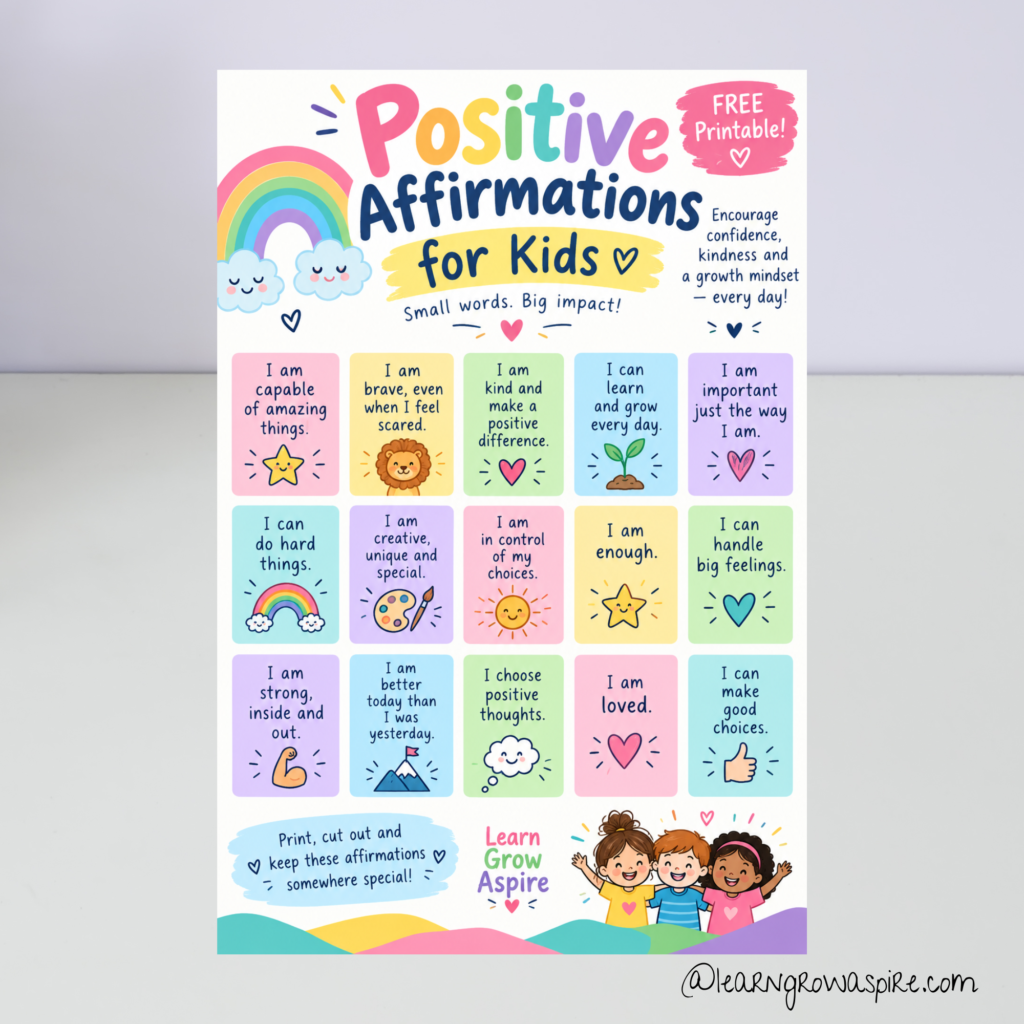
I created this free positive affirmations printable for kids to make it easy for you to bring positive self-talk into your kids’ everyday routines.
The printable includes colorful affirmation cards that children can cut out and keep somewhere special, or you can leave it as it is, frame or post it on a wall, bulletin board, etc.
Grab the Free Printable
Click on the link below to snag your free printable PDF!
Tips for Making Affirmations Meaningful
If you want affirmations to become more than something children simply repeat, keep these ideas in mind.
Keep them realistic – an affirmation should feel encouraging without requiring a child to pretend they don’t have difficulties.
“I can keep trying” may be more helpful than “Everything is easy for me.”
Connect affirmations to action – Ask: “What could you do today that shows this affirmation?”
This helps children connect their words with behavior.
Let children choose – Whenever possible, give children several options and allow them to choose an affirmation that feels meaningful.
Don’t force positivity – Children should still be allowed to experience sadness, anger, worry, disappointment, and frustration.
Positive affirmations should support emotional expression—not replace it.
Model the language – Use positive self-talk yourself. Children notice how the adults around them respond to mistakes and challenges.
Positive Affirmations Can Be One Small Tool With a Big Purpose
Building confidence and resilience doesn’t happen because a child repeats a positive sentence once.
It happens through hundreds of little experiences.
A child tries something difficult.
They make a mistake.
Someone encourages them.
They try again.
Learn that asking for help is okay.
They discover that uncomfortable feelings eventually pass.
Realize that being imperfect doesn’t mean they’re incapable.
And slowly, they begin to develop a more supportive voice inside their own head.
That’s the bigger purpose behind positive affirmations for kids.
They’re not about convincing children that everything is perfect.
But rather about giving children encouraging words they can return to when things feel hard.
Whether you’re a teacher supporting SEL in your classroom, a counselor working with children on confidence and emotional regulation, or a parent raising a child who you want to grow into a kind, confident, resilient person.
These simple statements can be one small tool you add to your everyday routine.
I hope this free printable gives you an easy place to start.
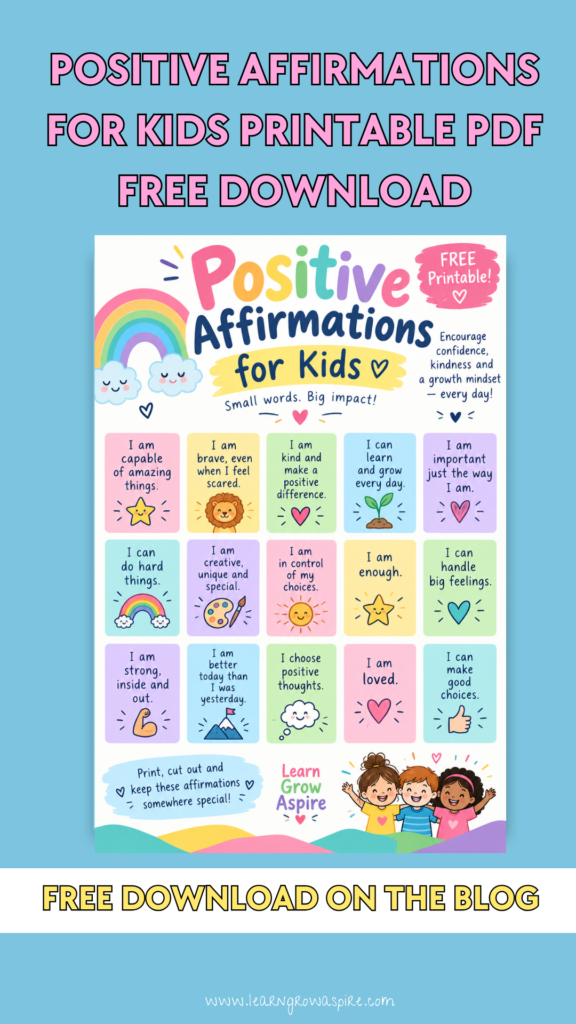
Pin This Free Printable Positive Affirmation PDF
Make sure to save this PDF to your Kids’ Pinterest SEL board so that you can easily find it when needed. And while on Pinterest, please follow me so that you will be notified when I add more resources like this one.
Some of the links in this post may be affiliate links. I’m also an Amazon Affiliate and will occasionally link to some of my favorite Amazon products. I will receive a small percentage back if you purchase through my link. You won’t be charged a penny more if you shop through my links. That said, I do NOT recommend anything I do not use and love! Thank you for helping support my blog!


Leave a Reply