One of the most valuable social-emotional skills we can build in a child is helping them cope with disappointment. Whether it’s a cancelled recess, a lost game, a friend who didn’t invite them to their party, or a grade that didn’t match their effort. The ability to move through disappointment — rather than get stuck in it — shapes how a child handles every setback that follows. In today’s post, I share 5 strategies to help kids cope with disappointment.
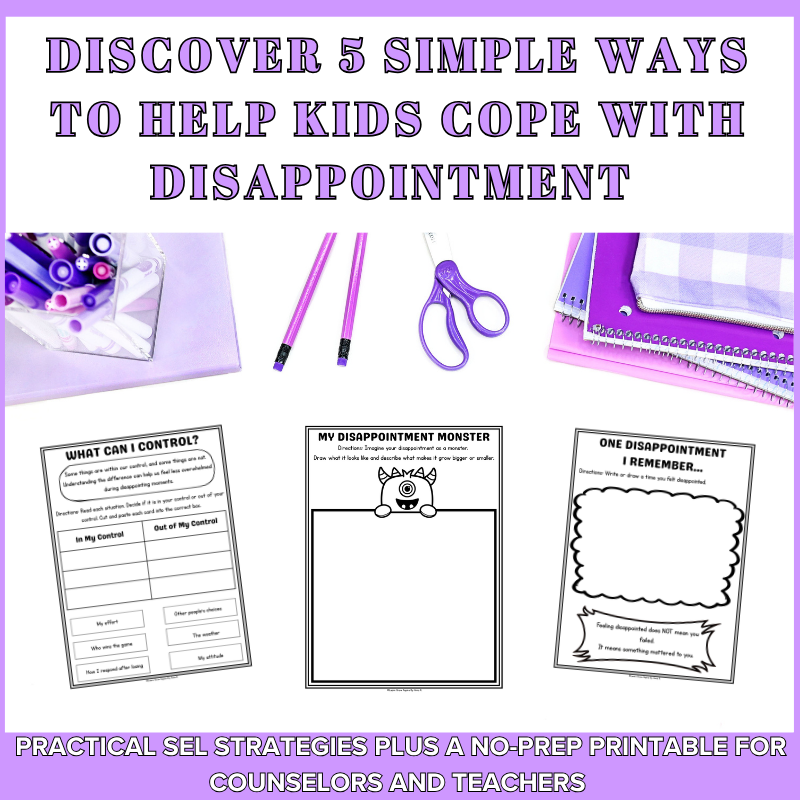
Chances are you’ve probably seen disappointment play out in every possible way: the meltdown at a desk, the silent withdrawal, the “it’s not fair” spiral that derails an entire afternoon.
The good news is that kids don’t need to be shielded from disappointment. Instead, they need to be taught how to work through it. And when we as adults model that process consistently, disappointment becomes one of the strongest builders of long-term resilience.
5 Strategies To Help Kids Cope With Disappointment
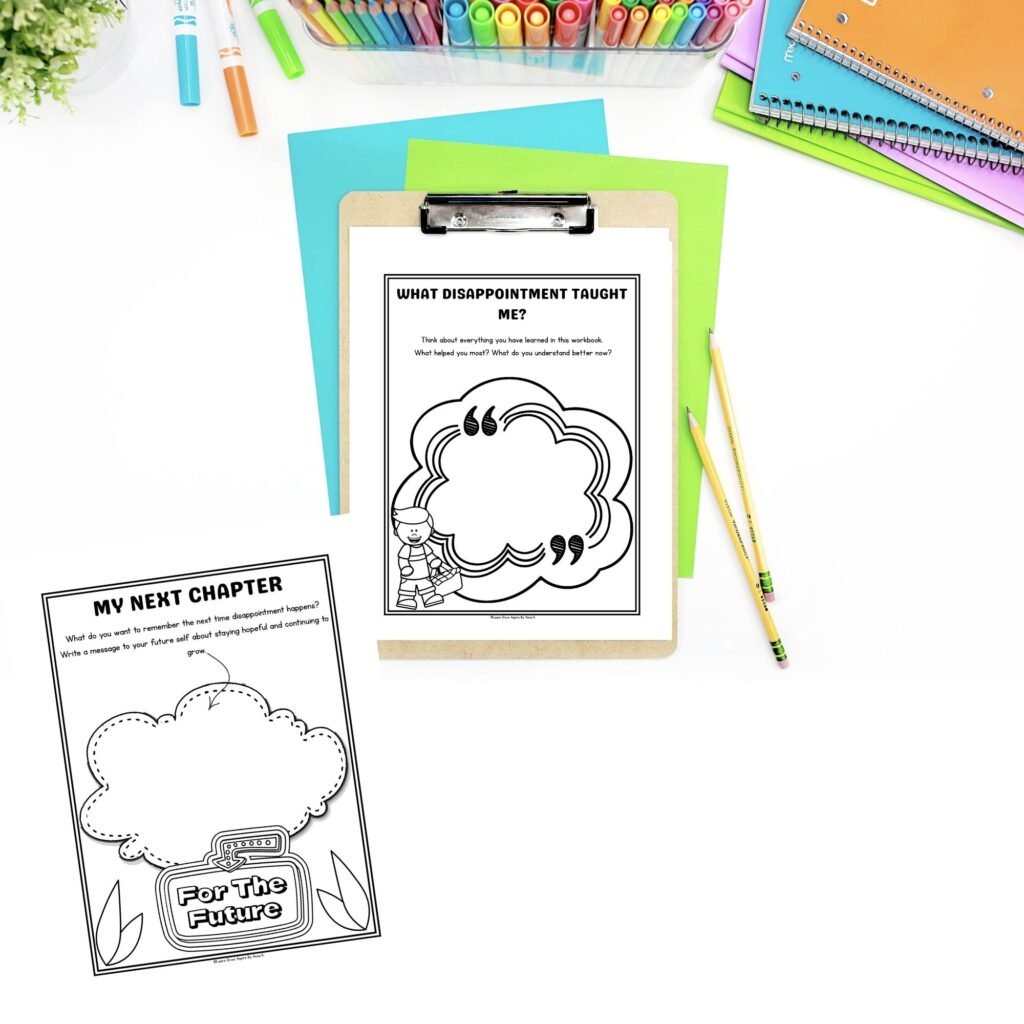
Here are five practical, classroom- and office-ready strategies for supporting children through disappointment.
1. Name the Feeling Before You Try to Fix It
Before jumping to solutions (“Let’s think of something else fun to do!”), give the emotion a name. Kids can’t regulate what they can’t identify. Simple language like “It looks like you’re feeling really disappointed right now” does more than a well-meaning distraction ever will — it tells the child their internal experience makes sense and has a word attached to it.
Try this: Download our feelings chart and keep it visible in your space. When a child is dysregulated, point to it rather than asking them to explain verbally — many kids can point before they can put the feeling into words.
2. Teach the Body-Brain Connection
Disappointment isn’t just a thought — it’s physical. Tight chest, clenched fists, hot face, a lump in the throat. Helping children notice where they feel an emotion in their body builds body awareness, which is a foundational piece of emotional regulation and a key step in teaching kids to manage disappointment on their own.
Try this: Use a simple body outline and have your student or child color or mark where they feel the emotion. This turns an abstract feeling into something concrete they can observe — a first step toward managing it rather than being overwhelmed by it.
3. Separate the Event From the Story
A lot of a child’s distress after a setback doesn’t come from the event itself — it comes from the story they tell themselves about it. “I never get picked.” “Nothing good ever happens to me.” “I’m bad at this.” These thoughts snowball fast, and left unchecked, they shape how a child interprets every future disappointment.
Try this: Gently separate fact from interpretation. “You didn’t get picked for the team today” is a fact. “I’m always left out” is a story. Naming that difference out loud, without dismissing the feeling, is one of the simplest ways to build disappointment coping skills that stick.
4. Build a Coping Menu — Before They Need It
The middle of a meltdown is the worst time to introduce a new strategy. Kids regulate best when they’ve already practiced tools during a calm moment and can reach for something familiar under stress.
Try this: Create a simple “coping menu” with 4–5 options a child helped choose themselves (deep breathing, squeezing a stress ball, drawing it out, taking a break corner, talking it through). Giving kids ownership over the list makes them far more likely to actually use it when a real disappointment hits.
5. Normalize Setbacks as Part of Growth
Kids who see disappointment as evidence something is wrong with them struggle far more than kids who see it as a normal, survivable part of trying things. Reframing setbacks as information rather than failure is one of the most protective mindsets you can build early. And it’s central to helping children cope with disappointment in a lasting way.
Try this: Share small, age-appropriate examples of your own disappointments and how you handled them. Modeling an “I felt disappointed, and here’s what I did” narrative shows kids that resilience isn’t about not feeling upset — it’s about knowing what to do next.
Why Structured Resources Make This Easier
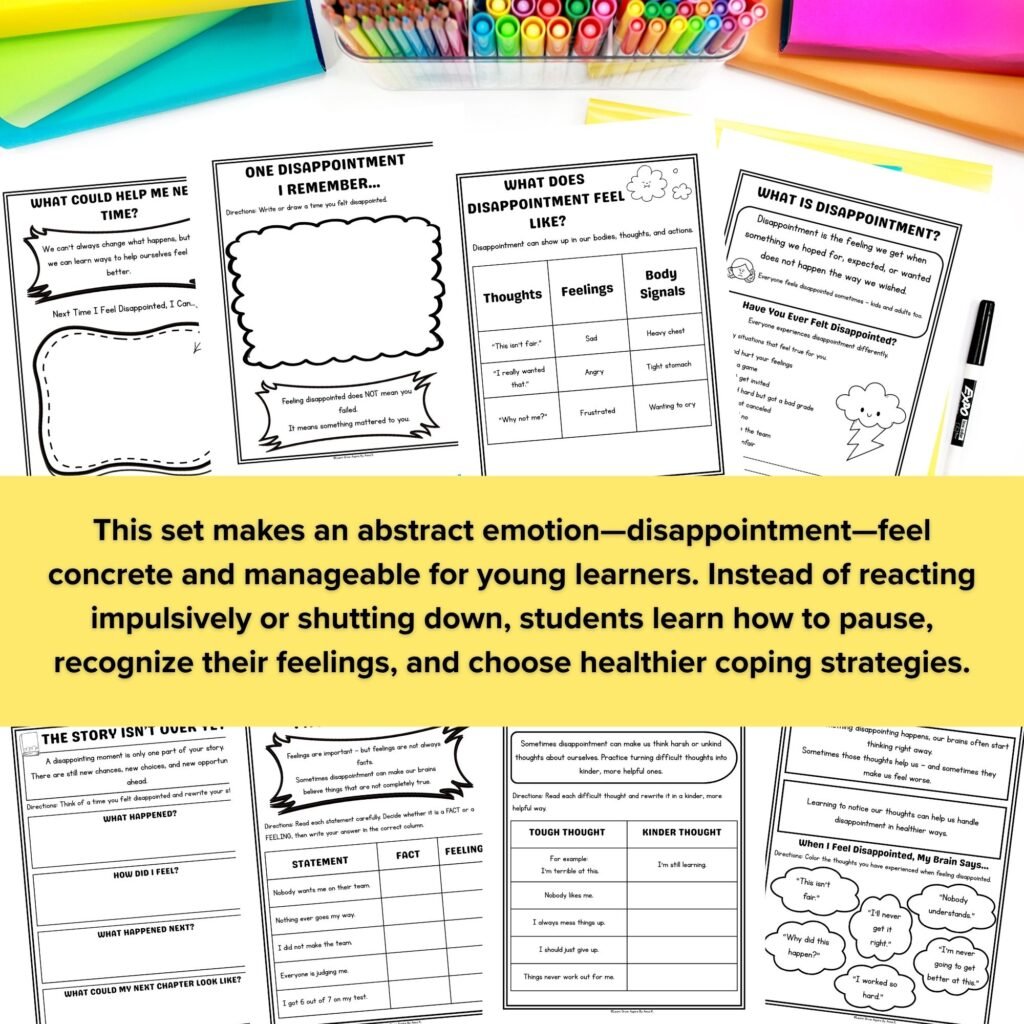
These strategies work best when they’re consistent, repeatable, and easy to fit into an already-packed day. That’s exactly why so many counselors and teachers lean on printable SEL worksheets rather than building disappointment activities from scratch every week — it saves prep time while giving kids the same structured, therapeutic framework session after session.
If you’re looking for a ready-to-use resource that walks kids through exactly the process above — identifying disappointment in their body and thoughts, challenging negative self-talk, and practicing healthy coping strategies — our disappointment printable packet for kids was designed for exactly this.
Inside, students work through activities that help them:
- Identify what disappointment feels like in their body, thoughts, and actions
- Recognize real-life situations that trigger disappointment
- Understand and challenge negative self-talk
- Explore healthy, independent coping strategies
- Build emotional vocabulary and self-awareness
- Strengthen resilience after setbacks
It’s a print-and-go, no-prep PDF — ideal for individual counseling sessions, small groups, or a whole-class SEL lesson.
SHOP DISAPPOINTMENT WORKSHEETS FOR KIDS PRINTABLE PDF
Disappointment Worksheets For Kids Printable
Disappointment will never fully go away — nor should it. It’s a normal, unavoidable part of childhood, and every time you help kids cope with disappointment in the moment, you’re building a skill they’ll carry into every future setback.
As counselors, teachers, and/or parents, the goal isn’t to shield children from disappointment. It’s to hand them tools sturdy enough to carry them through it — again and again, until coping becomes second nature.
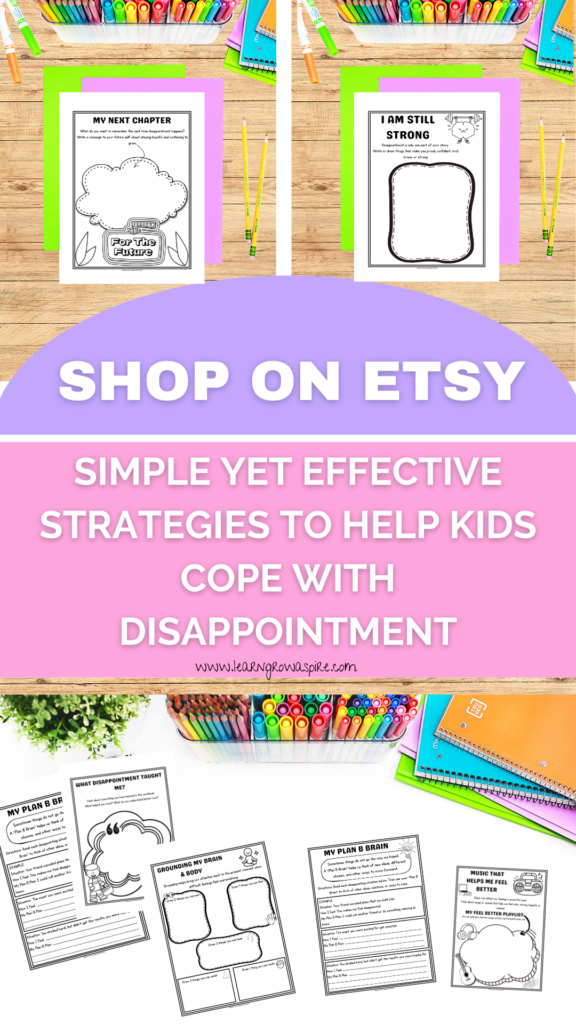
Pin These Simple Yet Effective Strategies To Help Kids Cope With Disappointment
Make sure to save these strategies to your SEL activities for kids Pinterest board. And while on Pinterest, please consider following me on the platform.
Some of the links in this post may be affiliate links. I’m also an Amazon Affiliate and will occasionally link to some of my favorite Amazon products. I will receive a small percentage back if you purchase through my link. You won’t be charged a penny more if you shop through my links. That said, I do NOT recommend anything I do not use and love! Thank you for helping support my blog!


Leave a Reply