If you’ve ever asked a teen to clean their room, start their homework, or even just get out of bed before noon and been met with a blank stare or a flat “I don’t feel like it” — as a mom of a teen, I can assure you, you’re not alone. Struggling with teen motivation is one of the most common (and most misunderstood) challenges parents, school counselors, therapists, and teachers face.

Understanding what’s really going on beneath an unmotivated teenager’s behavior — and having the right tools to address it — can make a whole lot of difference.
Our instinct is often to label it as laziness. But in most cases, what looks like laziness is actually something deeper: burnout, anxiety, executive functioning struggles, or a teen who genuinely doesn’t know how to get themselves unstuck.
Understanding the real reasons behind teen motivation struggles — and having the right tools to address them — can make all the difference.
In this post, we’ll break down what low motivation in teens really looks like, why it happens, and practical, research-informed strategies you can use to help. We’ll also share a few tools that make this work easier to put into practice.
What Low Teen Motivation Actually Looks Like
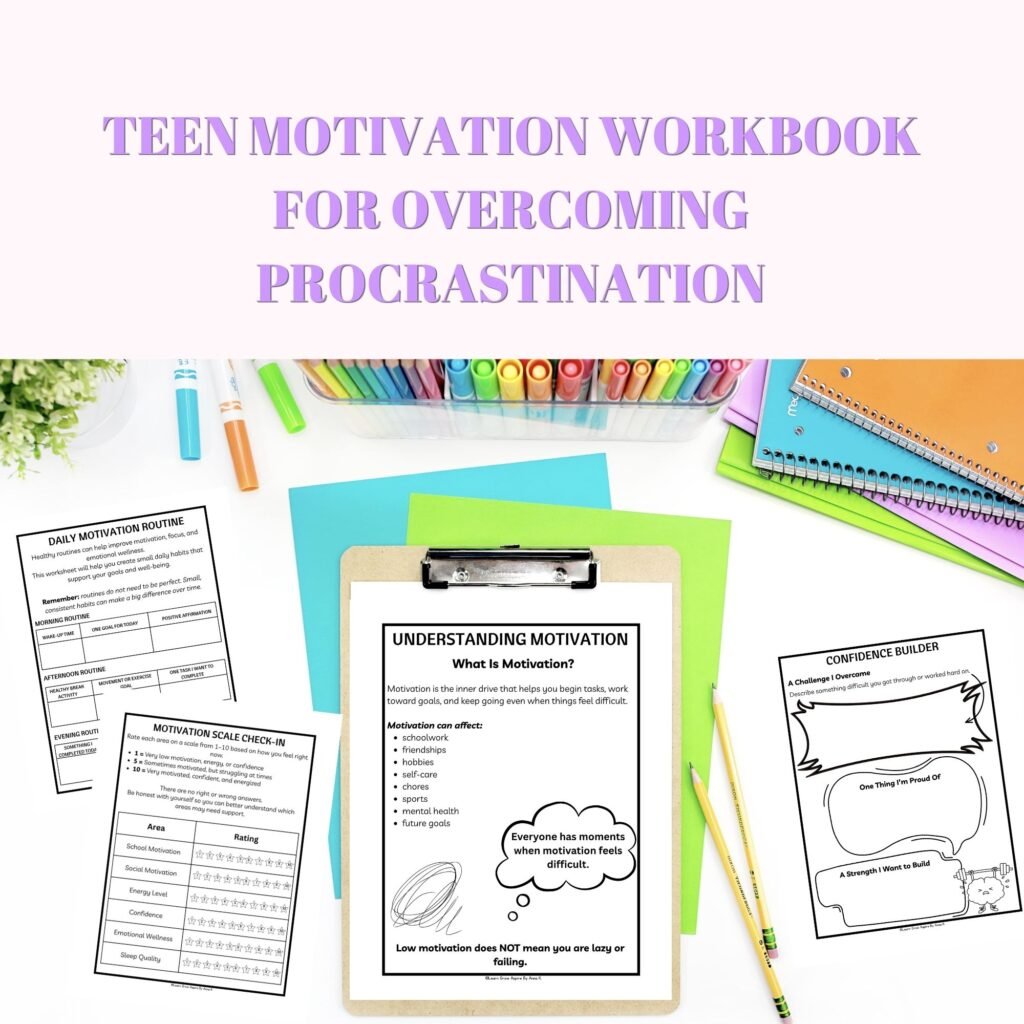
Motivation issues in teens rarely show up as simple stubbornness. More often, low teen motivation looks like:
- Procrastination that seems illogical — putting off tasks they know will only get harder the longer they wait
- Emotional flatness or irritability when asked to start something
- All-or-nothing thinking (“If I can’t do it perfectly, why bother?”)
- Physical signs of exhaustion — sleeping more, low energy, frequent complaints of being tired
- Withdrawal from activities they used to enjoy
- Difficulty starting tasks, even ones with clear steps and deadlines
- Increased screen time as an escape or coping mechanism
If you’re noticing a cluster of these signs — not just an occasional “I don’t want to do my homework” moment — it’s worth looking past the surface behavior and asking what’s driving it.
Laziness vs. Burnout: Why the Distinction Matters
One of the most important shifts we, as adults, can make is moving away from the “lazy teen” narrative.
Laziness implies a choice — a teen who could do the task but simply won’t.
Teen burnout, on the other hand, is what happens when a young person’s internal resources (emotional, mental, and physical) are depleted faster than they can be replenished — and it’s one of the biggest hidden drivers of low teen motivation.
Teen burnout can come from a mix of sources:
- Academic pressure — constant testing, grades, and college prep stress
- Social pressure — navigating friendships, social media comparison, and fitting in
- Overscheduling — packed extracurricular calendars with little downtime
- Family expectations — real or perceived pressure to succeed
- Undiagnosed anxiety or depression — which often masks itself as apathy in teens
- Executive functioning challenges — difficulty with planning, prioritizing, and task initiation, which is common in teens with ADHD or learning differences
When adults respond to burnout with punishment or pressure (“Just try harder,” “You’re being lazy”), it typically backfires — deepening the shame and avoidance rather than resolving it. Teens experiencing burnout need support that rebuilds their sense of capability, not consequences that reinforce the idea that something is wrong with them.
The Procrastination-Burnout Cycle
Here’s something that might just surprise you – procrastination and burnout often feed each other in a loop.
Like this:
- A teen feels overwhelmed by a task (schoolwork, chores, a big project).
- They avoid it to escape the discomfort — this feels good in the short term.
- The task doesn’t go away; it often gets bigger (more due dates pile up, consequences accumulate).
- The teen feels more overwhelmed and more behind, which increases shame and anxiety.
- That shame makes starting the task even harder, so they avoid it again.
This cycle can repeat for weeks or months, and without intervention, it tends to escalate rather than resolve itself. Breaking the cycle isn’t about willpower — it’s about interrupting the pattern with structure, smaller steps, and emotional support.
Practical Strategies To Help Teens
The good news is that teen motivation is a skill that can be rebuilt — it’s not a fixed trait some teens have and others don’t.
Here are some strategies that actually help address teen procrastination and low motivation in teens.
1. Normalize the Struggle First
Before jumping into solutions, teens need to feel understood. A simple, non-judgmental check-in (“I’ve noticed things feel harder for you lately — want to talk about it?”) does more to open the door than any lecture about responsibility.
2. Break Tasks into Smaller, Specific Steps
Vague goals (“do better in school”) are overwhelming and hard to act on. Guiding our teens with specific, small steps (“open your laptop and write one sentence of your essay”) lowers the barrier to starting — and starting is usually the hardest part.
3. Address the Underlying Emotion, Not Just the Behavior
Ask what’s actually happening underneath the avoidance.
Is it fear of failure? Feeling behind? Not knowing where to start? Anxiety about being judged?
The right support depends on the root cause, not just the visible behavior.
4. Build in Recovery Time
Teens experiencing burnout need rest that actually restores them — not just less structured, but more screen-filled, time. Encourage genuinely restorative breaks: movement, time outdoors, creative activities, or simply unstructured downtime without a device.
5. Use Structured, Guided Reflection Tools
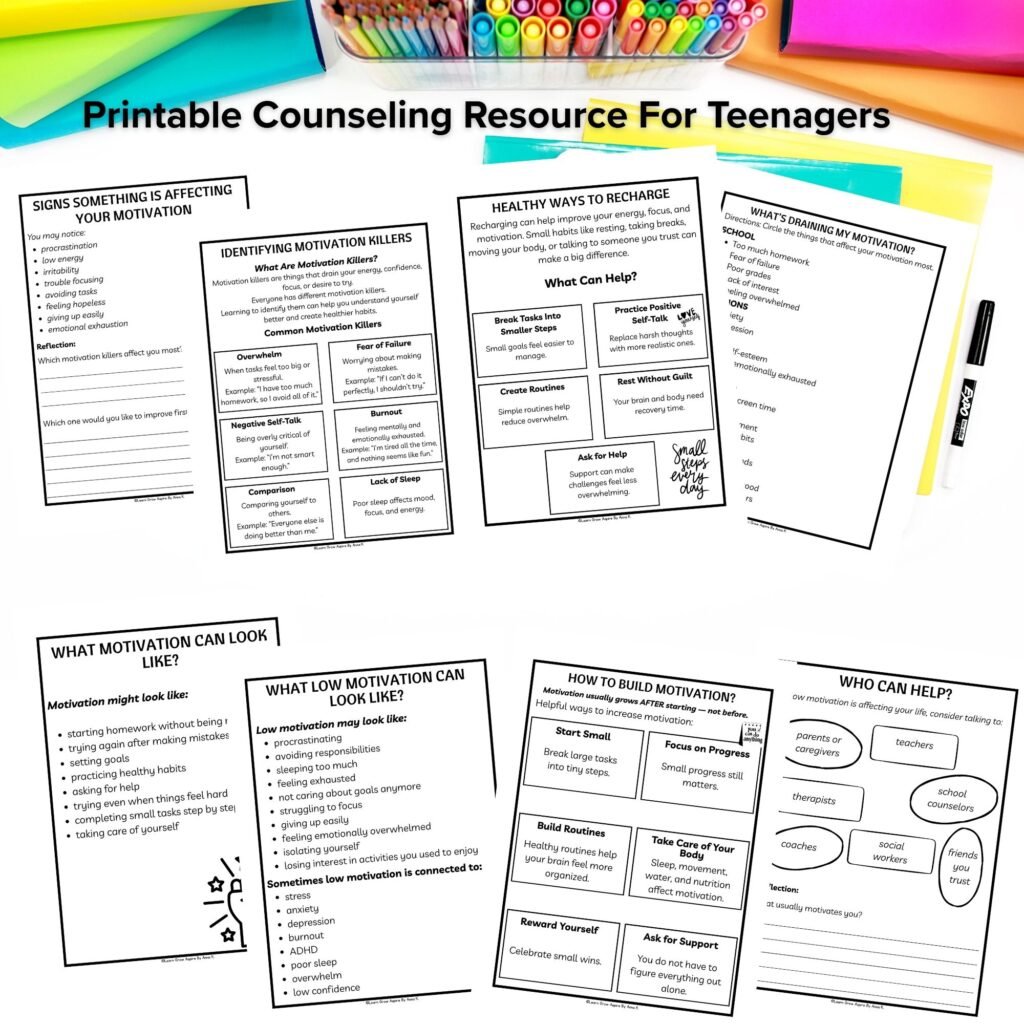
This is where worksheets and guided activities become especially valuable. Teens — especially those who struggle to identify or articulate their feelings — often do much better with structured prompts than open-ended conversations. A well-designed worksheet can walk a teen through:
- Identifying what’s draining their motivation
- Recognizing early warning signs of burnout before it escalates
- Practicing small, achievable goal-setting
- Reframing negative self-talk into something more constructive
- Building a sustainable daily routine
6. Celebrate Small Wins
When motivation is low, even small completed tasks are real progress. Acknowledging effort — not just results — helps rebuild a teen’s confidence that they can follow through, which is often the missing piece.
Why Structured Worksheets Work So Well for Teen Motivation
If you work with teens — whether as a parent, therapist, school counselor, or educator — you’ve probably noticed that open conversations about teen motivation and burnout can sometimes fall flat. Teens often shut down when asked directly, “Why don’t you want to do your homework?” It can feel like an interrogation.
Guided worksheets sidestep this.
They give teens a low-pressure, private way to process what’s going on, reflect at their own pace, and build self-awareness without feeling put on the spot.
They’re also incredibly practical for group settings — SEL classrooms, counseling groups, or therapy sessions — because they give every teen the same structured framework to work through, while still allowing for individual reflection.
This is exactly why we created the Teen Motivation Workbook: Overcome Burnout, Procrastination & Build Healthy Routines.
Introducing the Teen Motivation Workbook
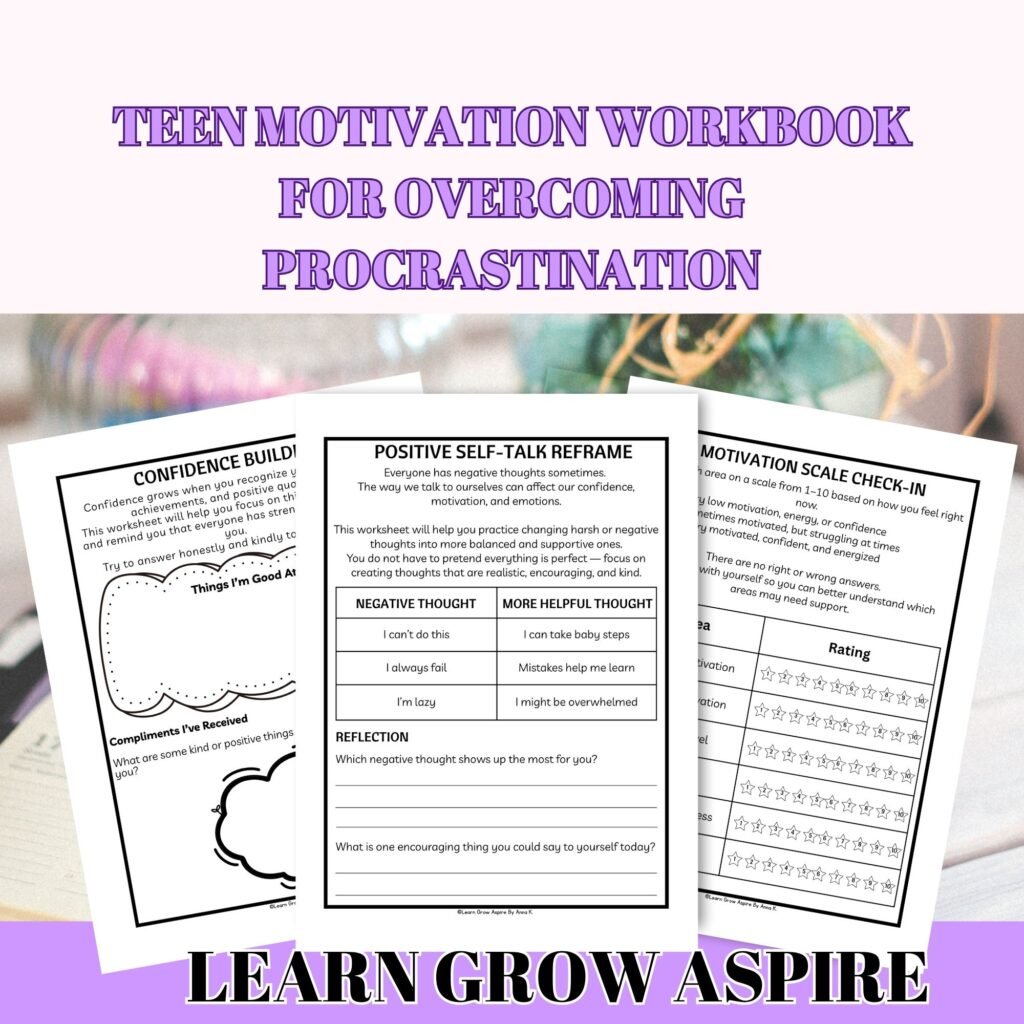
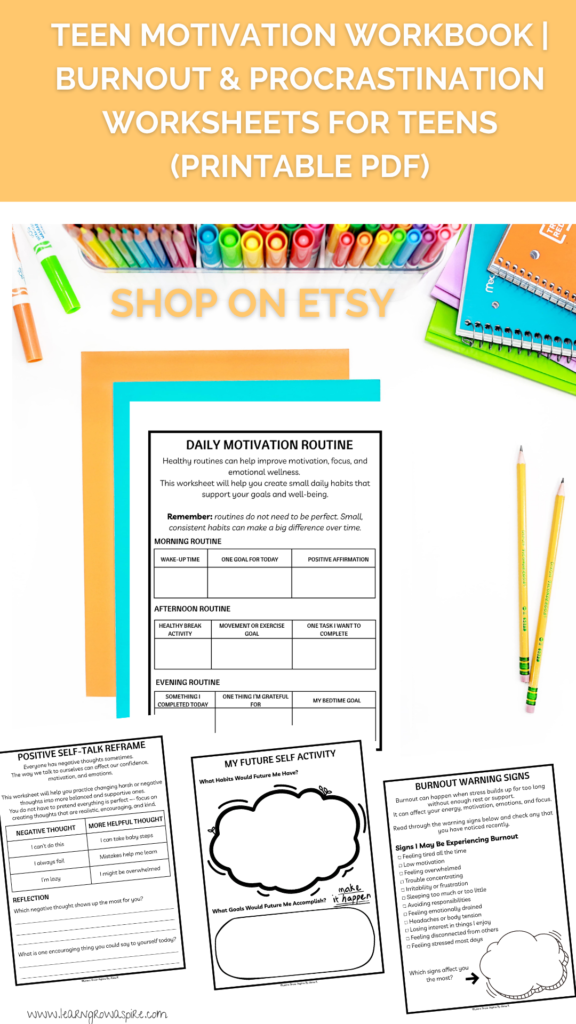
Our printable, instant-download teen motivation workbook was designed specifically to help teens understand why their motivation dips, recognize the early signs of burnout, and build sustainable habits — all through guided, teen-friendly worksheets that make hard conversations easier to have.
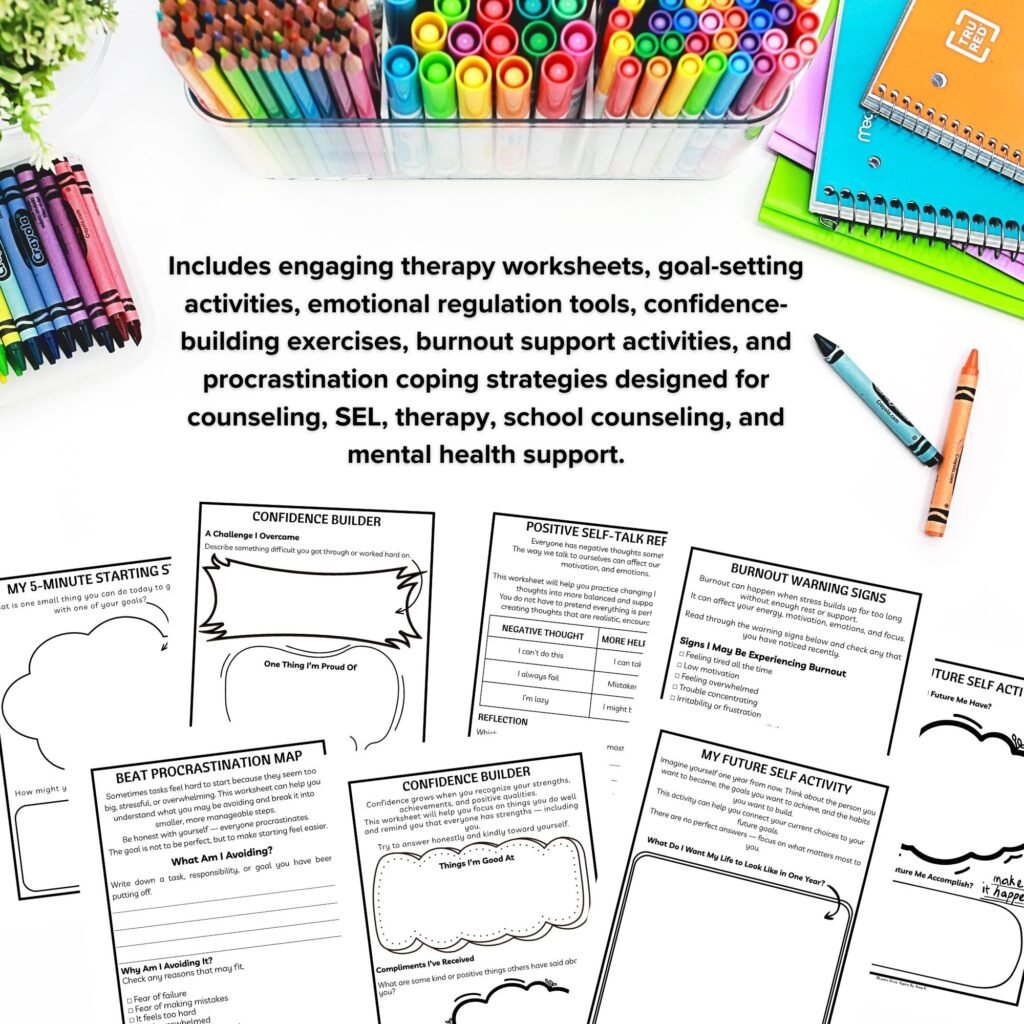
Inside, you’ll find:
- Understanding Motivation Information Sheets — teen-friendly explanations of what motivation actually is and why it fluctuates
- Motivation Check-In Worksheets — quick, low-pressure ways for teens to track how they’re feeling over time
- Goal Setting Activities — structured, achievable goal-setting that avoids the overwhelm of “big picture” planning
- Procrastination Coping Tools — practical strategies for breaking the avoidance cycle
- Confidence-Building Exercises — activities that rebuild a teen’s belief in their own capability
- Burnout Warning Signs Worksheets — helping teens (and the adults supporting them) catch burnout early
- Positive Self-Talk Activities — reframing the inner critic that often fuels avoidance
- Future Self Reflection Activities — connecting daily actions to bigger goals and values
- Daily Motivation Routine Pages — building small, sustainable habits
- Emotional Wellness & Coping Skills Worksheets — rounding out the emotional regulation piece that underlies motivation struggles
This workbook was built with therapists, school counselors, social workers, parents, and teachers in mind — anyone supporting a teen through procrastination, burnout, or emotional wellness challenges.
It works well one-on-one, in small groups, or as part of a larger SEL curriculum, and it’s ready to use immediately: just download, print, and go — no prep required.
SHOP TEEN MOTIVATION WORKBOOK PRINTABLE PDF
The Bottom Line on Teen Motivation
Low teen motivation is rarely about laziness — it’s usually a sign that something deeper needs attention: burnout, overwhelm, anxiety, or simply not having the tools to know where to start. The adults supporting these teens don’t need to have all the answers. What helps most is patience, structure, and the right tools to make hard conversations and hard habits a little easier to build.
If you’re supporting an unmotivated teenager who’s stuck in the burnout-procrastination cycle, the Teen Motivation Workbook was designed to make that process simpler — for both of you.
Grab the Teen Motivation Workbook on Etsy
Other Blog Posts You May Enjoy Reading
- Goal setting for middle school students
- Insecurities for teens worksheets
- Self-compassion worksheets for teens
- 9 Ways to help teens build resilience
Pin These Teen Motivation Worksheet PDF
Make sure to save these motivation worksheets for teens to your teen therapy Pinterest board so that you can easily access them when needed. And while on Pinterest, please consider following me on the platform.
Some of the links in this post may be affiliate links. I’m also an Amazon Affiliate and will occasionally link to some of my favorite Amazon products. I will receive a small percentage back if you purchase through my link. You won’t be charged a penny more if you shop through my links. That said, I do NOT recommend anything I do not use and love! Thank you for helping support my blog!

