Social conflict resolution activities have become one of those things I strongly believe every upper elementary teacher needs on hand.
Why?
Because some days the student drama is just nonstop.
And I’m not even referring to the major behavior issues.
I’m talking about the constant “little kids” problems that somehow eat up your whole day.
Someone is upset because their classmate rolled their eyes at them. Or perhaps, a student feels like their friend is ignoring them.
Two students are arguing over whose turn it is to be the line leader. Another kid tattles because another kid “looked at them weird.”
And…. before you know it, you’ve spent twenty minutes solving social issues before you’ve even started your first lesson.
It’s draining!
Sometimes you probably feel like you are part teacher, part counselor, part conflict referee.
And, my friend, well, that’s quite exhausting!
But here’s the thing. While these peer conflicts may seem small to us, to kids, they feel extremely huge.
And a simple misunderstanding can quickly turn into:
- crying,
- refusing to work together,
- hurt feelings,
- mean comments,
- silent treatment,
- tattling every five minutes,
- Or feeling completely checked out.
And then there goes your lesson again! Not fun, right?
Social Conflict That Gets Frustrating as Teachers
Here’s what I’ve noticed.
A lot of children genuinely do not know how to work through social conflicts.
We tell them things like:
- “Use your words.”
- “Be kind.”
- “Work it out.”
- “Talk nicely.”
The truth is, a lot of kids have no clue what that actually looks like when they’re angry, embarrassed, frustrated, or feeling left out.
So what happens, then?
Students – interrupt lessons, accuse and blame one another, they tattletale, shout rude comments to each other, and the list goes on.
And then we end up doing the same mediation speech over and over and over.
You know the one that goes like –
“Tell me what happened.”
“Okay, now let the other person talk.”
“How do you think they felt?”
“What could you do differently?”
By the third conflict of the day, you’re tired of hearing yourself.
That’s why I’m a huge believer that conflict resolution is not something we can just expect kids to magically know.
Instead, they need practice. Real practice over and over again.
Especially in upper elementary, where friendships start getting complicated, and students become much more reactive socially.
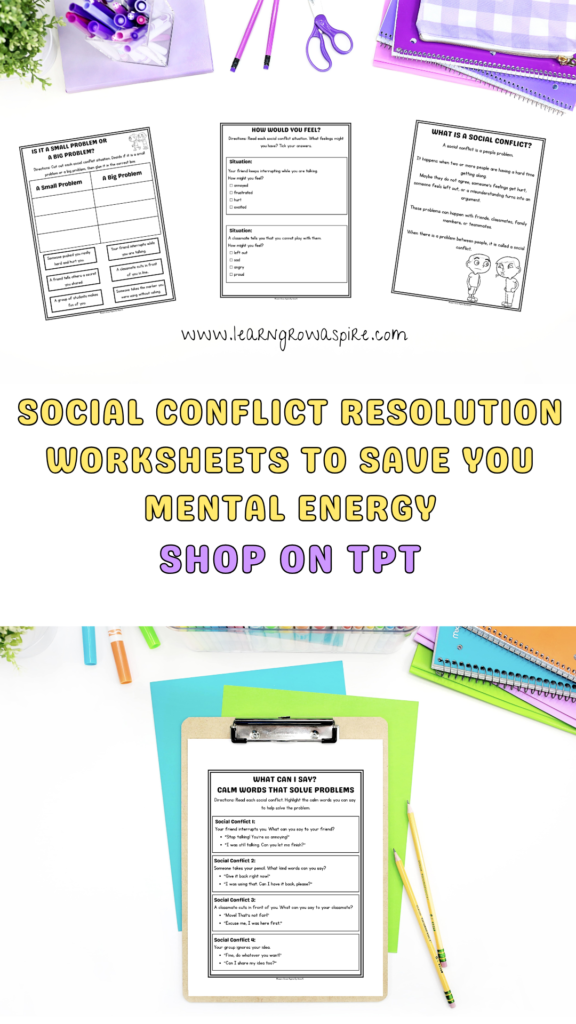
Social Conflict Resolution Worksheets To Save You Mental Energy
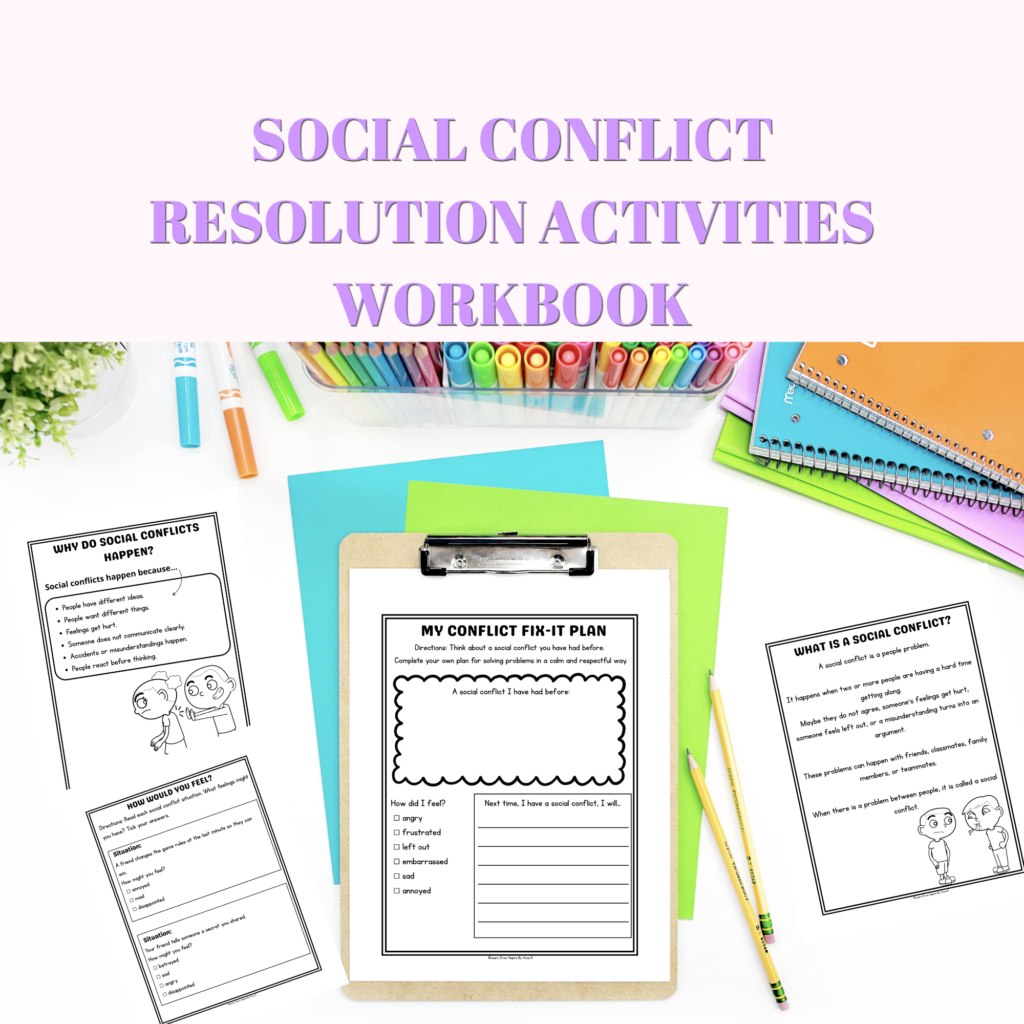
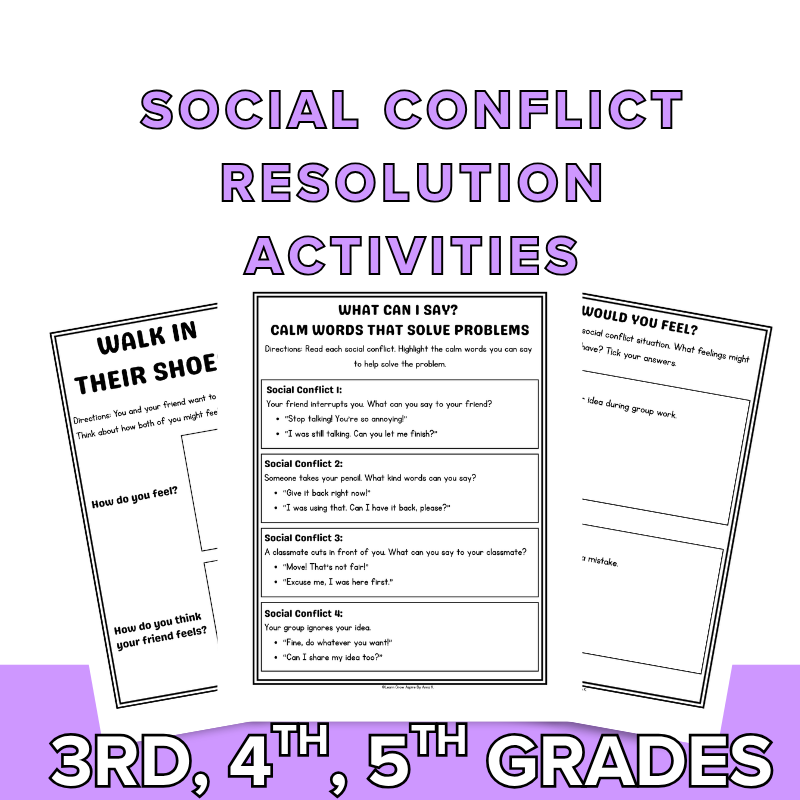
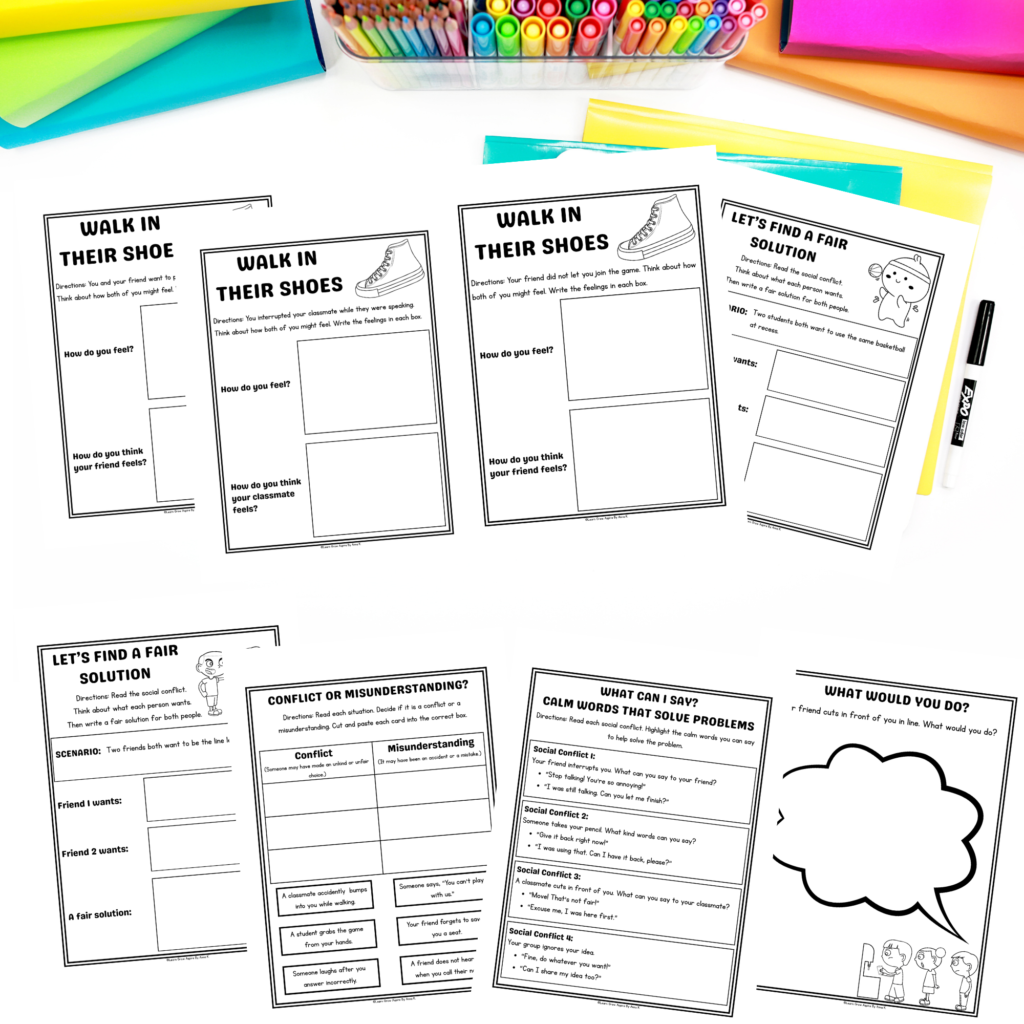
This is exactly why I wanted to share this Social Conflict Resolution Activities Workbook for 3rd, 4th, and 5th Grades.
Because sometimes we do not need another complicated SEL lesson to prep from scratch.
We need something we can print, hand out, use in small groups, use during counseling time, use during morning meeting, or pull out after one of those rough social weeks.
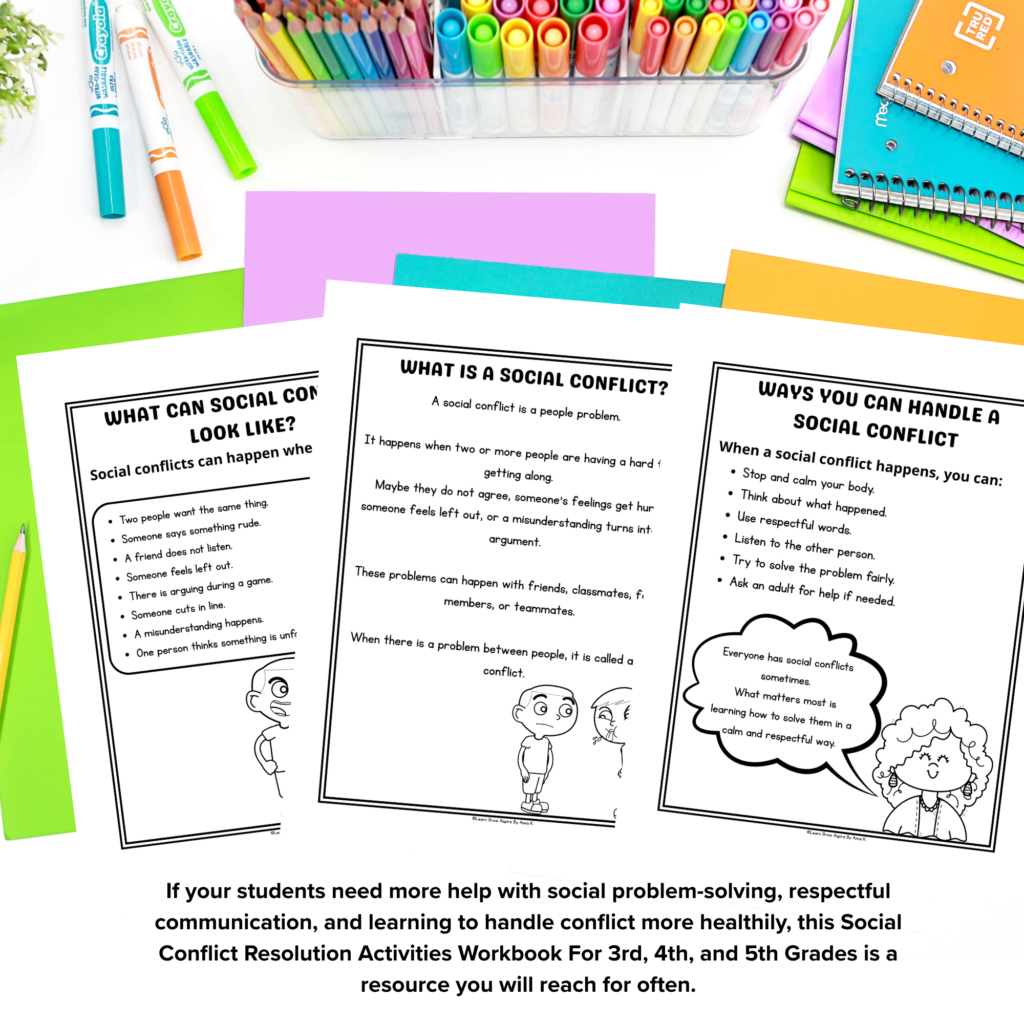
This workbook walks students through:
- understanding what social conflict actually is.
- Why disagreements happen.
- How misunderstandings grow.
- Seeing another person’s point of view.
- Thinking before reacting.
- Using respectful communication.
- And working toward solutions that are fair.
So instead of us constantly being the middle person fixing every argument, students start learning the thinking process behind solving these situations. Because the goal is not just to stop one argument.
The goal is to slowly build students who can handle the next disagreement better than they handled the last one.
This Printable Workbook Will Make Classroom Life Easier
If you are wondering if these social conflict resolution printable PDF worksheets will actually make your life easier.
The answer is – YES!.
Because when your students have zero conflict resolution skills, every single little disagreement becomes your emergency.
And this means – you are stopping guided reading, pausing math, handling recess fallout, and hearing tattling during transitions.
It never ends.
But when students start practicing:
- perspective taking,
- calming down before reacting,
- problem solving,
- respectful discussion,
- compromise,
What happens?
You begin to notice fewer instant explosions.
Not perfect — because kids are kids.
But better.
And better matters.
Even if it means one less friendship meltdown during centers.
Or, students start trying to use words before running to you.
Or they can process a disagreement on paper and talk through it with more maturity.
That is less on your shoulders.
And I think like most teachers, you are craving anything that gives you less social refereeing and more time to actually teach.
If You Are Tired of Constant Peer Drama
I say this all the time:
Upper elementary students are still learning how to be people.
They are learning how to disagree, what it is like to feel left out, be annoyed, as well as how to communicate, handle unfairness, and deal with not getting their way.
And those lessons show up in our classrooms every day, whether we planned for them or not.
So having structured social conflict resolution activities ready to go just makes sense.
Especially on those weeks when your class feels emotionally messy, and everyone is setting each other off.
This workbook gives you a simple, low-prep way to target those exact skills without adding more to your planning plate.
And sometimes that is exactly what we need.
SHOP SOCIAL CONFLICT RESOLUTION PRINTABLE PDF WORKBOOK ON TPT
Other SEL Posts You May Enjoy
Here are some other blog posts you may be interested in:
- Think it or say it: How to teach kids to pause before speaking
- How to teach personal boundaries to kids
- How to help kids deal with embarrassment
Pin These Social Conflict Resolution Activities
Make sure to save these worksheets to your Social Stories For Kids Pinterest board so that you can easily find them when planning your lessons. And while on Pinterest, please consider following me.
Some of the links in this post may be affiliate links. I’m also an Amazon Affiliate and will occasionally link to some of my favorite Amazon products. I will receive a small percentage back if you purchase through my link. You won’t be charged a penny more if you shop through my links. That said, I do NOT recommend anything I do not use and love! Thank you for helping support my blog!
